

Team Aham?
about some confusing takes on Lindy West's new book and common misunderstandings about polyamory

I have read so many thinkpieces on Lindy West’s memoir and subsequent armchair relationship analyses about its content (not to mention the adjacent thinkpieces on polyamory and the near-universal agreement that her husband is an asshole) that I thought actually reading the book myself would be redundant. I’m glad I read it anyway, though, because there are some interesting details consistently left out of all the thinkpieces, or interpreted in ways completely baffling to me, that make me suspect we’re all using this guy as a proxy to attack some other thing of our choosing.
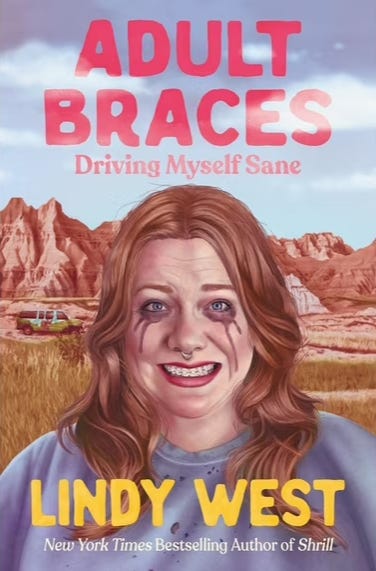
Adult Braces is, first and foremost, an incredibly uncomfortable read. I wanted to find a way to have a contrarian opinion about all of this, but I just can’t, at least here: the self-loathing is palpable and I couldn’t help but feel sorry for her throughout much of it. I personally hate when people feel sorry for me while I’m actively trying to be self-deprecatingly funny, so I hope that’s not what I’m doing to her, but... that's how I read the book.
I was also angry on her behalf more than once. If we take her words at face value — not always easy to do after reading her many admissions of what she omitted from her previous memoirs — she’s been very rudely mistreated throughout her life. A part that sticks out to me as particularly degrading was how the station for her show Shrill, based on her memoir and life and for which she was a writer, sent her series finale gifts to “Linda West,” and included a hard-bound photo book in which she was not included even once. The disrespect she experienced on set was honestly appalling. She is remarkably self-aware about this, though, and does a pretty compelling job retroactively analyzing why she thinks she had such a bad experience on set.

Most people who bother to have a public opinion about this book seem to be, to some degree or another, outraged on West’s behalf. They see her having been manipulated into letting her husband fuck whoever he wants while she’s stuck paying the bills and listening to him have sex with their shared girlfriend she never wanted, surrounded by sad stuffed animals, being tucked into bed like a child (a take I now think was exaggerated and characterized as something much worse or weirder than it was).
This characterization is an easy one to make because West isn’t shy to admit that she feels and often acts like a child and enjoys being taken care of, because she is depressed and anxious and it feels exhausting to do on her own.
...And this leads to the first mischaracterization I found among The Concerned: the suspicion that her brief mention of having a temporary, vaguely Dominant/submissive dynamic with Aham to help get her out of her personal slump was, in fact, Aham apparently coercing her into a sexual kink she didn’t want, either. Meg Keene writes:
So when she asks for help—maybe he can assist her in picking up the pieces of her own life? Perhaps he can participate in SIMPLE FUCKING TASKS in their marriage like washing the dishes? He agrees! (Wonder of wonders.) But only after he tells her that now they are in a dominant/ submissive relationship and she’s the sub.
She goes on to quote a part of the book where West describes a really simple dynamic where Aham tells Lindy to do the basic shit for herself that she needs to do to be a functioning human every day while he takes care of a bunch of the housework, because she will listen to him, not herself. As West says in the passage just before the one Keene quotes:
In early COVID and early couples’ therapy, when despair was the only color left on my palette, when I was slogging through each day in what I can only describe as “panic, but make it tired,” when the best ten-year plan I could come up with was to get frozen into a glacier, I asked Aham to tell me what to do.
As I struggled through that overwhelming onslaught of days and nights unfortunately called life, with a sharply diminishing grasp on how to navigate money, career, food, body, friendship, marriage, parenting, nonmonogamy, sleeping, being awake, getting older, and, suddenly, a global pandemic, I had nothing left. Why did I have to make all the choices? Couldn’t I outsource that? Abdicate the throne of life to someone who knew me best, who, at least at that point, believed in my potential way more than I did?
Emphasis mine. Why was it left out that she asked him to tell her what to do? It sounds like she literally initiated this arrangement and he was simply happy to agree. Where does the claim come from that he has now unilaterally declared them to be in a D/s situation? Where is this alleged “emotional abuse” she earlier accuses him of? West goes on to describe their setup:
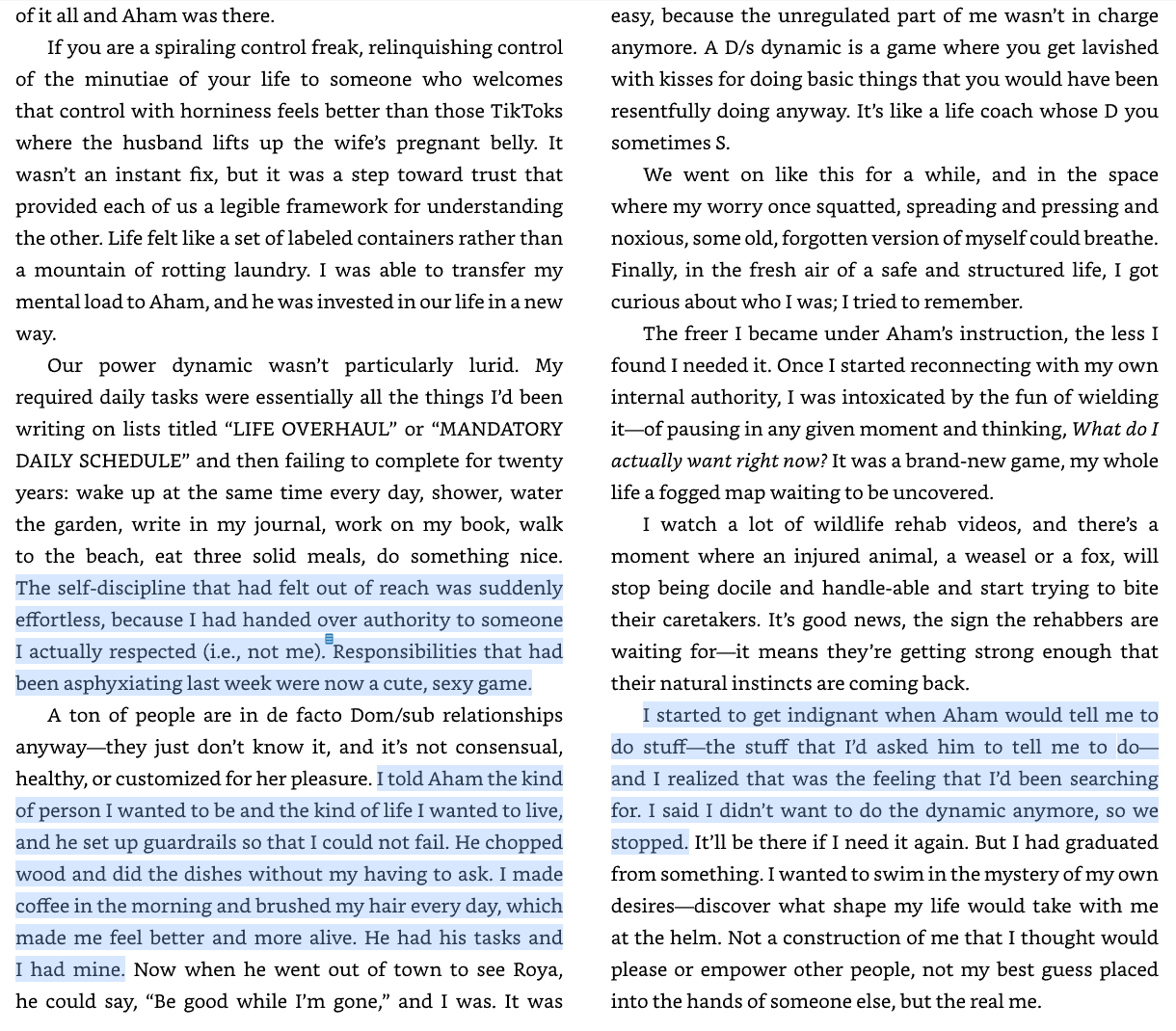
If you are a spiraling control freak, relinquishing control of the minutiae of your life to someone who welcomes that control with horniness feels better than those TikToks where the husband lifts up the wife’s pregnant belly. It wasn’t an instant fix, but it was a step toward trust that provided each of us a legible framework for understanding the other. Life felt like a set of labeled containers rather than a mountain of rotting laundry. I was able to transfer my mental load to Aham, and he was invested in our life in a new way.
Our power dynamic wasn’t particularly lurid. My required daily tasks were essentially all the things I’d been writing on lists titled “LIFE OVERHAUL” or “MANDATORY DAILY SCHEDULE” and then failing to complete for twenty years: wake up at the same time every day, shower, water the garden, write in my journal, work on my book, walk to the beach, eat three solid meals, do something nice. The self-discipline that had felt out of reach was suddenly effortless, because I had handed over authority to someone I actually respected (i.e., not me). Responsibilities that had been asphyxiating last week were now a cute, sexy game.
This may not be the best way for people to routinely or permanently go about managing their own lives, but it’s something she frames as a kind and effective— and temporary— setup she and her husband had, not something good for everyone, and not something she was coerced into. She is literally expresses her gratitude for this dynamic.
Even if I broadly agree with some tenor of the endless book-takes1 when it comes to having compassion for West’s obvious self-esteem issues and the feeling that Aham threatened to abandon her (even though that’s not really how it appeared to go), disordered eating habits, and other mental health issues that have affected her all her life, so many people have such bad book-takes, focusing on what I think are the wrong (or irrelevant) things, and in all the wrong ways.
Besides West’s particular background story leading up to accepting this marriage as it’s structured now, people are predictably using the opportunity to argue why Polyamory is Bad for Everyone. The most annoying of these takes are usually based on a misunderstanding and subsequent flattening of the different types of polyamorous relationships people engage in (and why, and with whom), or a bad personal history with just one (currently trending) kind. Now, I’m no expert, but, consider the following:
Polyamory and polygyny are not synonyms
Polyamory is a broad umbrella under which romantic and sexual partners have permission to also have other romantic and sexual partners. Couples negotiate this permission in many different ways, and it looks different in many cases. I hate to use such a clichéd “um ackshually,” but there are many ways to be “poly.” Polygyny can be one way, but it’s sure not the only way, nor is it the most common among the type of poly PMC liberal elites everyone complains about and blames so many divorces on.
Polygyny is specifically a man with more than one female partner. The female in the polygynous scenario is expected to be involved only with her husband, while he is able to have more than one female partner or wife. Polygyny is most common among certain African and Middle Eastern cultures (and some remote desert towns populated by fundie LDS and portrayed sympathetically on one of my favorite shows, Big Love), not the pale rationalists of Silicon Valley or the non-hierarchical anarchists of Portland or Minneapolis. In those cultures, the women get to do what they want, too.
In West’s marriage, she has also always been able to do what she wants. Of course, she didn’t want any of those options,2 so they were pretty useless to her, but she has them, nonetheless. It was never meant to be an asymmetrical arrangement favoring only Aham, especially when you consider that Roya is polyamorous, as well. If Lindy was interested, she would likely not have a problem hooking up with or dating other men. Women do generally have it easier in poly setups, (yes, even fat women who have more self-confidence than Lindy), although men like Aham predictably clean up.
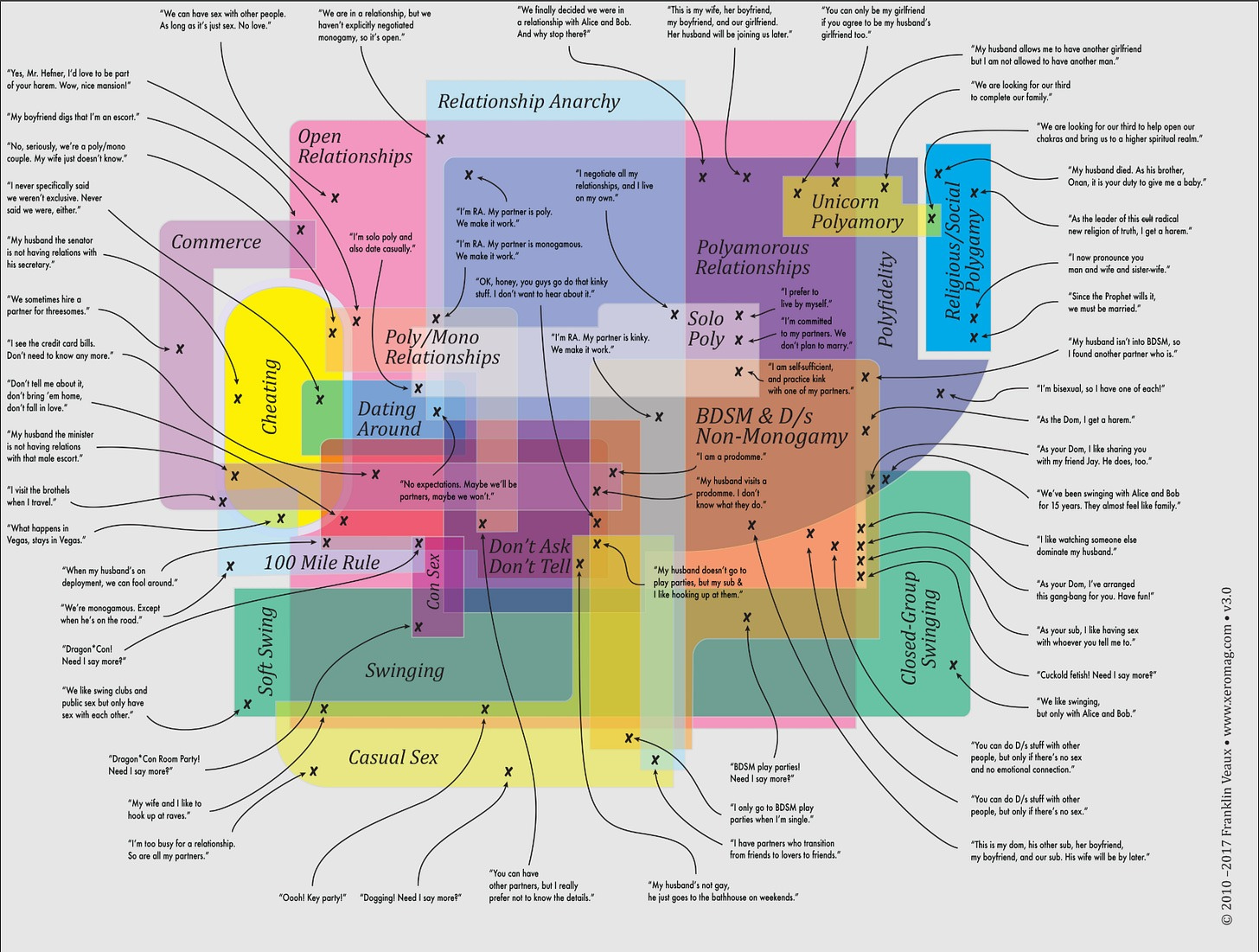
The distinction between polyamory and polygyny is important, because many people make arguments against polyamory based on an assumption that a douchey cad with some version of a modern harem is actually representative of poly and nonmonogamous relationships as a whole.
What’s funnier to me, though, is that there are basically two camps of people in this category who like to hate on nonmonogamy: those who hate it because they heard stories like West’s and feel bad for the woman, assuming the man manipulated the woman into it, and people who hate it because they know from experience that it’s often easier for women to date outside the relationship than it is for men, which they think is unfair to the man. These complaints usually involve fun words like “cock carousel” or “cuck,” needing someone to blame for the indignity of evolution. I don’t know why we like C-words so much.
Polyamory is not “when struggling monogamous couple opens marriage as last resort”
Another common misconception is that polyamory is when exclusive couples open up their relationships in some way or another, particularly after a long period of monogamy. Of course people do this, but it’s, again, not the way to be poly. Maybe the couple made this decision because someone was unfaithful and they thought this would heal the hurt that the betrayal caused, or prevent it from happening again, or because all their friends were doing it, or because they just read Sex at Dawn,3 or because they’re just bored and open-minded and want to see if it helps “keep the spark alive” or whatever.
Admittedly, Sex at Dawn ran rampant in my friend group after it came out, too, and yes, about half of them became poly, most people broke up (although not all), and my divorce from my first husband shortly after can be at least partially blamed on my being influenced by the book, although it would have happened anyway.4
People who disapprove of this practice, though, even rightfully, tend to start from this and make their arguments from there, excluding from their analysis any information about people who begin their open relationships in this manner, with the expectations of how it will work laid out up front, with people already used to doing this. Of course, the polyamorous or other poly or open relationships that start out that way are much more likely to succeed than whatever trashfire your monogamous friends decided to engage in because they thought it looked cool and enlightened.
As far as Lindy and Aham are concerned, they did not “open up” their monogamous relationship. He broke up with her, then they got back together later, under different terms. That is emphatically not the same as demanding your wife let you have a girlfriend eight years into your marriage.
Consensual nonmonogamy is, by definition, not cheating
Have you ever been cheated on? What is it that upset you so much about it? Was it only about what they did, or the fact that they did it after explicitly agreeing not to, and then tried to keep it a secret from you? My guess is it’s not just one thing, and it’s a lot more of the latter than we tend to give it credit for in these conversations. The breach of trust is the primary problem that the others stem from when someone cheats; there is no issue with trust if everyone is honest and agrees to the terms beforehand. It’s removed from the equation because it becomes easier to assume. But many people have a hard time believing this can be true for anyone else. Take this conversation in the comments of Kitten’s recent article on polyamory below:
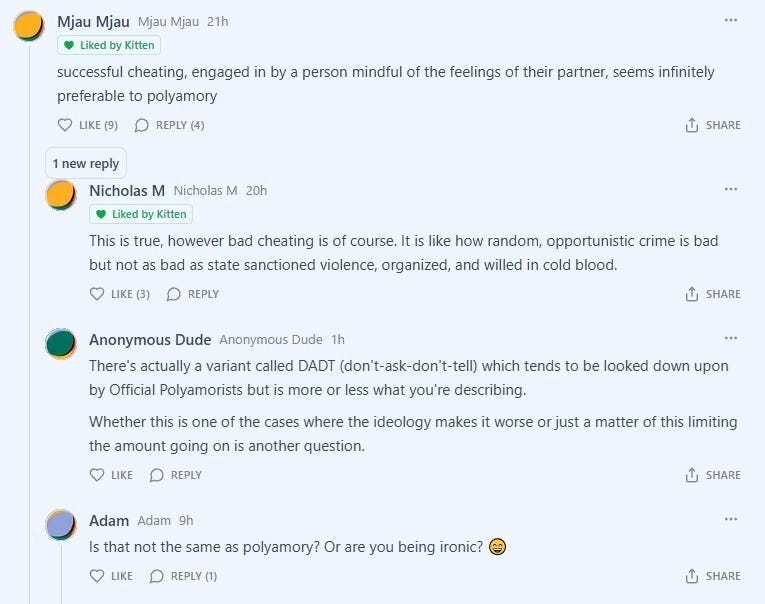
First, Mjau thinks active secret betrayal is better than honesty from the jump. Adam, however, thinks successful cheating and honesty from the jump are literally the same thing, implying that being “mindful of the feelings of their partner” can’t possibly include a mutual desire for this relationship style or the radical honesty it requires.
What makes polyamory different from cheating is, obviously, the permission and the honesty. It’s why all the communication jokes exist: you have to be willing and able to talk things through in order to ensure you are not being unintentionally dishonest with one another. Yes, it’s complicated, but it’s necessary if you want to live that lifestyle.
Lindy and Aham did not communicate, as much as Aham tried. Lindy explains how she went out of her way to avoid talking about it, deliberately willing herself to believe that his desire for polyamory was “theoretical” rather than real, agreeing to it but refusing to believe he meant it, hoping that she would never have to confront it again. When Aham did bring it up — frequently enough, according to Lindy — she would shoot him Looks and emotionally punish him in various ways for continuing to be exactly the person he told her he was in the beginning.
Make fun of all the communication as much as you want; for a lot of people, this isn’t a bug, but a feature. The thing about “incessant” communication is that, if done sincerely and with care, you always know what’s going on and you are able to set realistic expectations for yourself and others, and boundaries, appropriately. You are able to make informed decisions. You know where you stand, at all times. According to Lindy, it was she who refused communication and the honesty it required, not Aham.
Everyone is not as jealous as you are
Polyamorous people do seemingly feel less intense jealousy than strictly monogamous people as a whole, which makes this all much easier for them than it is for a freshly-open couple who is coming off of a decade or more of exclusivity with each other. It also makes it much easier for some people than others!
Jealousy is a normal human emotion, and as far as emotions go, it’s about my least favorite one to feel, and the immediate revulsion normies have to polyamory makes sense when you consider how most people feel about the idea of “sharing” their partner with someone else.
But everyone is not the kind of normie whose jealousy is great enough to overcome their desire, or seeming need, to live such a lifestyle. For them, it’s easy enough to train yourself out of some common jealous feelings or behaviors that are irrational or meaningless.
“If you have to train yourself to stop feeling a normal emotion, that’s a sign there’s something wrong.”
Disagree. First, normal emotions aren’t always rational in the context in which they’re felt. Training yourself out of “jealousy” is really shorthand for training yourself out of certain irrational reasons for jealous feelings, and learning how to tell the difference, and not to ruminate or try to control other people.
What people forget— critics and temporary monogamous converts alike— is that polyamory is not just a way to organize a relationship, it’s often based on a larger philosophy on how to live. Aham explains this to her when they initially negotiate their relationship after they consider getting back together after their first breakup:
In broaching nonmonogamy, Aham said that he wasn’t seeing anyone else, and this wasn’t about me—it was just a fundamental part of his ethos. He believed that monogamy was, at its root, a system of ownership.
If that’s not a philosophy you feel drawn or at least sympathetic toward, polyamory might not be right for you, or worth trying!
It’s also worth noting the infamous passage that comes right after that where Lindy surmises that perhaps she’s too white to get it:
I had to admit that perhaps I didn’t feel it as keenly, as a white person.
Cringe AF but I don’t know that we can say by this sentence alone that she’s doing anything other than bathing herself in white guilt all on her own, but sure, maybe Aham could have pressured her into believing this. But she doesn’t really tell us as much in the actual book! It reads like it is her own original thought.
Related:
Aham wasn’t the liar or manipulator in this situation
From Lindy’s own mouth/fingers, she was.
If I’m being really honest, I was engineering my backup plan: a total system collapse that I could blame on polyamory.
This is after we’ve already learned that she effectively shut him out every time he tried to be communicative about the structure of their relationship, and how she steadfastly avoided all mention of and conversation about it for eight entire years.
She also admits that she was punishing him when it finally came out that he was exactly who he said he was after the fan sent her the DM telling her that her husband was doing what polyamorous people in polyamorous relationships do sometimes— only, the fan didn’t know about the poly part because Lindy made sure it was a secret so that he would look like a cheater.
Maybe I feel some sympathy for Aham, the world’s current favorite villain, because I can relate. In a previous life, I was an outlier in that, probably as a result of feeling allergic to the idea of a “poly community” when I was interested in that kind of relationship, I did not know many other people I wanted to date who were also open to the idea of a more open relationship, so I was the rare woman out there trying to convince various monogamous men that some degree of openness was a good idea, sometimes to disastrous results. When we were on the same page and it worked, it worked well, but when it didn’t, it really sucked, and you learn that people should not be converted into such a lifestyle. If it doesn’t appeal to them, it’s not going to.
Aham tried to be honest from the beginning, after two failed marriages. West says outright, if not overly-apologetically, that she pushed him too fast into a relationship after his second divorce, and they ended up breaking up after a fairly short time. And, unlike many of the portrayals of this part of West’s story, the polyamory ultimatum was given to her after this breakup when they reunited in grief over her father’s death. He did not demand his partner become polyamorous or he would leave her.
If you read the book, it is weird to claim that’s what happened when it clearly says something else happened! An absolutely terrible time for West as it is, but also, he laid it out there before they could go any further and hurt her more, in order to be honest with her, and kept opening up the topic for conversation only to be stonewalled in response. He was giving her the ability to make an informed decision before she agreed to get back together with him. This was not a situation where he sprung polyamory on a desperate wife— they had barely known each other a year and weren’t even dating anymore! She explains it all right there in the book:
My life with Aham started out a mess. It was the first few weeks of 2011. He had just gotten divorced, but I fell in love right away. I pushed him. He wanted it—if there’s one impressive/excruciating thing about Aham, it’s that he doesn’t do anything he doesn’t want to do—but I know I pushed too hard, even as he was begging me not to. We moved in together and to another state within a year, a stupid, selfish move that hurt our families and took me away from my father in the last months of his life. It was too soon and I wanted it too much and we never got our rhythm back. A month after we moved, Aham broke up with me.
I think this is a severely overlooked part of this entire story. Critics cite this as evidence that he was a womanizer, already looking for wife number three to emotionally abuse, but it was in fact West herself that pushed him further than he openly said he wanted to go, too quickly, and then he predictably backed away. We don’t know how long they were apart before Lindy’s dad died and he came back to help her through her grief, but that’s when the negotiations for getting back together, not staying in an existing marriage or even LTR, began.
West says,
Aham always knew he wanted an unconventional relationship structure; I still felt safe in the tightness of jealousy. I’m not politically conservative, but I am reserved.
As we all know now, she hates the idea. Absolutely cannot stand it. But she agrees, anyway, albeit hesitantly and with her fingers in her ears.
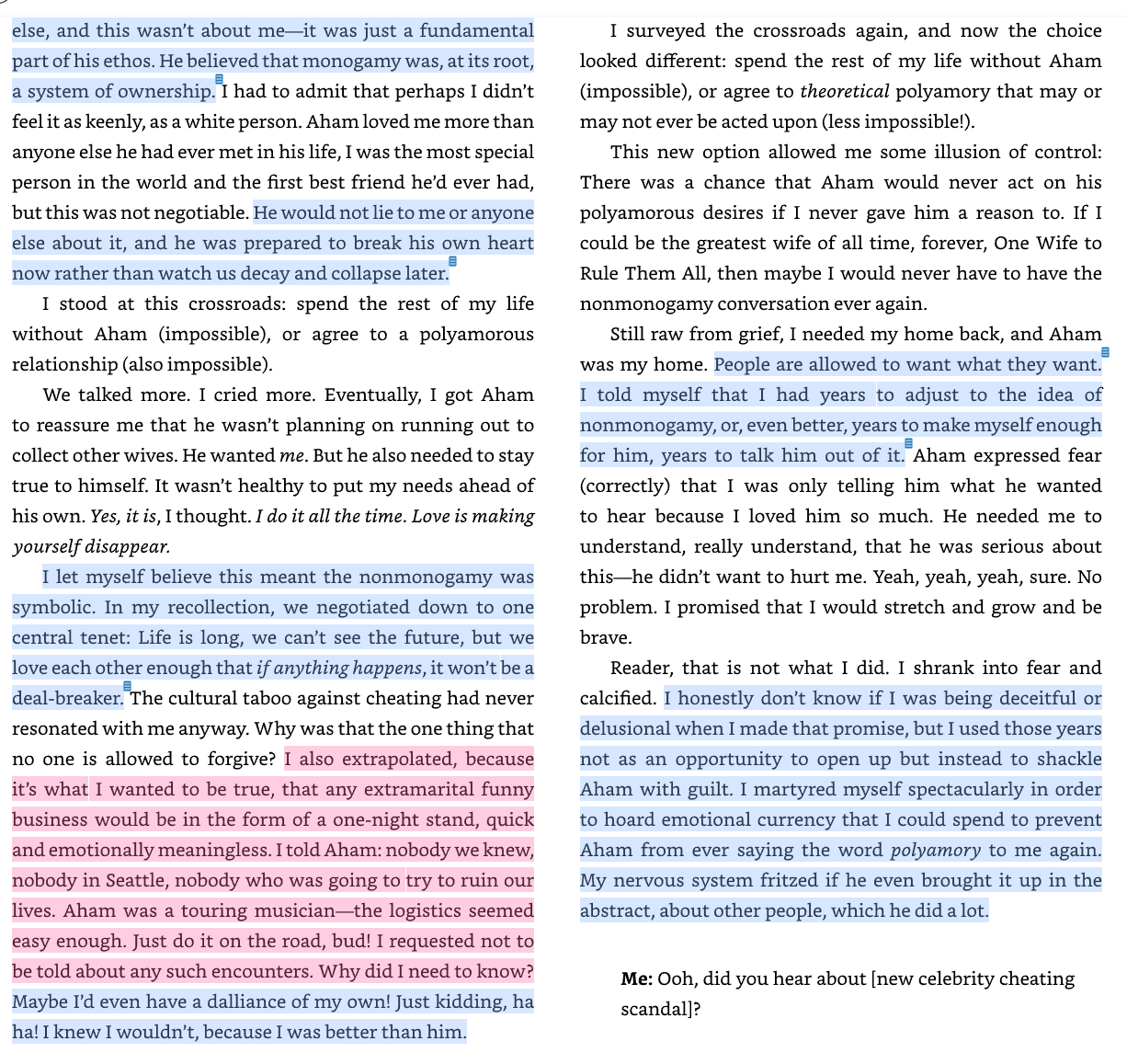
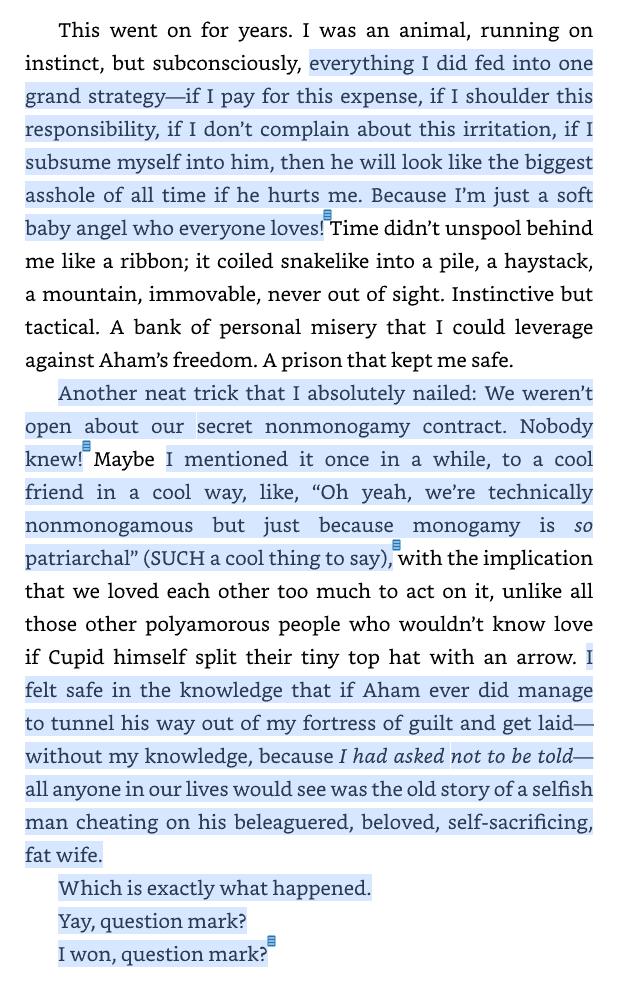
As noted in the book passage in the image above, immediately after the oft-quoted passage meant to cast suspicion on the character of Aham for his poor timing, West goes on to explain how she literally just tricked herself into thinking she could change him, and then she went on to manipulate the situation to ensure he looked like the bad guy if he were caught in public acting on what she gave him permission to do. Her pain and desperation is understandable, here; it’s the casting of Aham as the villain for bringing it up that I find objectionable. Although, to be fair, he could have told her they weren’t discussing getting back together until a few weeks had passed, allowing her to more thoroughly process her emotions, and they’d talked about what he needed for that to happen.
But still.
Where the poly critics are right
Monogamous couples should probably not open up their marriages! The only time I’d say “go for it” is if the relationship is about to die a fiery death, anyway, and this is their last remaining option and there’s a good reason for them to stay together, like they have kids or something (yes, I think you can be some version of poly and still raise kids healthily. You don’t need to have your entire cast of fuck buddies living in your basement or even introduce them to your children; there is no reason to believe this would be the common reality for anyone approaching some kind of open arrangement with any care).
But everyone else should probably leave it alone and stick to what they know, because people are going to be way more jealous than they think, probably jump in too fast without really knowing what they want, someone will be more hesitant, someone more successful, more disappointed, suddenly in love with their new boyfriend/girlfriend, whatever. There are probably better solutions to “fixing” your relationship. Sometimes even ending it.
This shit is not for everyone, and I think the primary reason is fairly obvious: most people are too jealous, whether you’re talking about multiple entire relationships, the much-maligned throuple like West’s, or just a “don’t ask, don’t tell” agreement that Lindy and Aham had in the beginning. And that’s fine. It seems pretty damn normal that it’s not fitting for everyone when you consider how easily most people accept monogamy and can’t fathom the idea of any level of nonmonogamy, even theoretically.
Speaking of which,
It’s okay to just quietly be a little weird
The age of normalizing shit is over. We are done now. We pronounced that dead sometime around November ‘24. We’re getting rid of normalizing and re-embracing our old friend, tolerance. No one needs to celebrate polyamory unless they want to. They don’t need to embrace it or think the people involved are cool for it. They just have to let people be who they are, as long as they’re not hurting anyone.
But are they hurting anyone, though?
I’m pretty sure at least part of the reason why so many people with brand-new or freshly-public negative opinions about polyamory hate it so much is because the people who are actually successful at it aren’t their friends, and they don’t know them. Those folks hang out with each other, not usually many monogamous people, and not people in unhappy monogamous marriages in which the husband tries to convince his sad and reluctant wife to let him fuck younger, skinnier women and it all goes predictably up in flames.
People who are committed to living this lifestyle publicly typically keep their dating lives to themselves, which I guess sounds contradictory, but really isn’t. They’re not going to hide it, but most who are hardcore into the lifestyle for more ethical reasons aren’t trying to convert normies. The ones everyone’s got an opinion about right now are the asshole men with the sad wives, but they’re conflating them with the poly commune folks and swinging couples who don’t care what anyone else does.
Besides being annoying as fuck, the surge of newbies into any fringe group that infects the mainstream can, usually by way of elite culture essays in fancy mags, in certain contexts, cause real problems. Testimony from Kitten and Kryptogal (Kate, if you like) about their monogamous friends opening up their marriages to utter disaster come to mind. KryptoGal wrote a note about it:
And Kitten describes his own experiences watching his friends go down the same spiral:
In the early 2010s a polyamory fad swept through my social scene like crack through a black ghetto. No marriage or long-term relationship that dabbled in ethical-non-monogamy survived the decade. Many didn’t survive the year. The relationships opened up, then fell apart. Children of these couples were made to adapt to a rotating cast of new partners coming in and out of their lives, to mom or dad being absent with lovers on evenings or weekends, and then finally to parents who didn’t live together anymore.
There are countless stories like theirs, and there are many “formerly poly” people on Substack who’ve weighed in pretty evenly on the topic (hello). But it can’t be denied that this way of doing it usually ends in disaster.
Now, hear me out, but people make the same kinds of arguments against trans youth medicine. It’s not like experimenting with being gay by making out with or dating someone for a couple months before deciding, yeah, turns out you’re still straight, where no one is negatively impacted by the experience. On the other hand, if “experimenting” with one’s gender includes the permanent effects of hormones or even irreversible surgeries, it’s more worrisome to more people to allow simple “experimentation” if it goes beyond the social sphere, and more gatekeeping is often desired, and actually possible through regulatory measures restricting medical and surgical options to certain ages and other psychological factors ensuring it’s the right treatment for the patient.
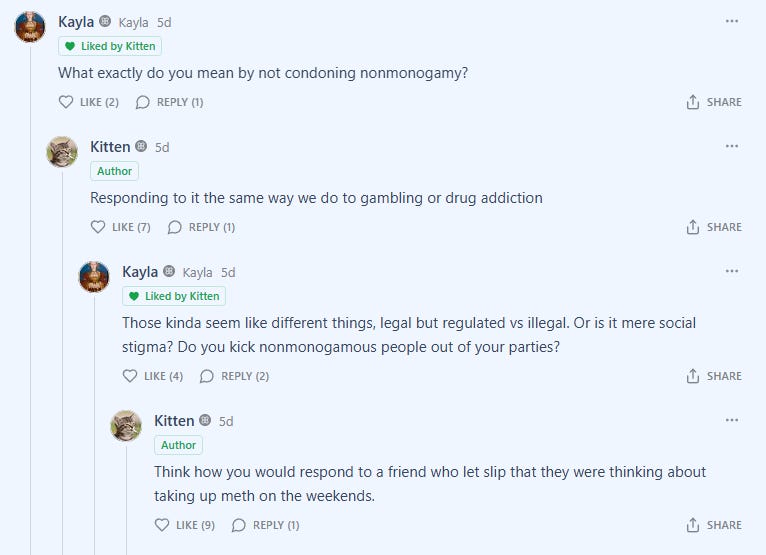
But how do you do that with polyamory? If you are really afraid it’s going to ruin marriages across the country (and probably further destroy the birth rate, because why not throw that in there), what would you have us do? Kitten’s response in the comments of his article aren’t terribly objectionable, although I’m much less disgusted by the whole thing, myself, and wouldn’t really compare polyamory to meth:
Is polyamory an “infohazard” and therefore actually hurting uninvolved people?
Is it too influential an idea to the people in their social circles, most of whom are probably not suited for the practice? Well, I hate the idea of infohazards on principle, first of all. It’s so insulting to assume we’re too mentally ill-equipped to handle seeing something like poly couples without hastily adopting the practice ourselves with no critical thought or consideration for existing relationships. But unfortunately, the idea that humanity is actually as intelligent as I want everyone to assume of one another is a utopian pipe dream, so, I hate to admit it, but there’s probably something to the infohazard idea.
There probably is merit to the idea that certain types of ostensibly private “degeneracy” should be kept reasonably taboo (but still legal) in polite society, but that there is a thriving “alternative” fringe of people who are tolerated as such by said polite society as long as they don’t go around giving the kids bad ideas or something. Everyone mostly just keeps within their circles that already broadly agree on how their particular alternative lifestyles all work.5 You know, like the olden days, but less violently repressive, because violent repression eventually leads to situations where everyone is suddenly trying to be queer poly communists.
But also, there are a whole lot of couples that are just discreet about their various nonmonogamous “agreements” that you’re not hearing from, because that’s what discreet means. They don’t tell everyone about their personal relationship details except maybe a few close, open-minded friends. They don’t write out of touch NYT op-eds from Manhattan penthouses or even Substack articles or even know what Substack is. They are private and otherwise “normal” from the outside; they just have an unconventional private relationship that works for them and they don’t really need to tell anyone about it, or justify it to you, you nosy weirdos.
I suspect that people might not be so mad at polyamory as much as they’re mad at some loud freaks they see on the internet, or the irresponsibility with which people they know changed the foundations of their existing relationships like it was an easy fad based on the lives of those internet freaks. But the people who fall under this oft-maligned umbrella are a wide variety of people with a wide variety of practices that don’t threaten anyone and don’t really make sense to hate so rabidly if you can take the time to separate them by type.
Anyway, going back to being weird, the thing about being a weird outlier in some way is that it’s fun. A little secret degeneracy in one’s life can be a good thing for some people, to a point. But degeneracy is not, by definition, normal, so the bar to clear is growing ever higher with each thing we normalize. Stop normalizing: make degeneracy easier and more fun again.
My ultimate verdict on this story is that it’s painfully clear that Lindy West’s self-esteem is in the toilet, and I don’t think she was trying to hide that. My unsolicited guess is that she probably agreed to this not because she felt any initial pull toward polyamory (or Roya), but because she conveniently stopped hating the idea6 and didn’t want to lose her husband, who was her most prized claim to the life she always wanted but always felt was out of reach; and also, sorry to say, her husband actually sounds a lot more honest than people are giving him credit for, although he also sounds like an immature, self-involved dork online. That said, I might, too, if my wife wrote a book explaining how she lied to me about what she wanted in our marriage and plotted for years to ruin my reputation, then the public made me out to be the asshole.
The book was often painful to read because of how desperately honest she was about how much she disliked herself, and the sad stories she had about men and dating and being bullied for being fat, and you can’t help but sympathize with her for how hard it’s all been for her. She was basically a femcel most of her life before we even made that word a thing. I also admire that kind of honesty, even when I get the dreaded secondhand embarrassment about it.
Also, the road trip seemed like a lot of fun, and it sounded like it really helped her in a lot of ways, not just with her marriage.
Maybe their relationship won’t work out, and maybe we’ll see a divorce memoir with more omissions from this one admitted in it, I don’t know. Maybe there is something inherently fucked up about their particular situation. I also don’t know that, and I really can’t! I am just going to trust that she probably is happy with her choices, at least now like she says, and that she doesn’t really owe anyone else an explanation for that. Or for her choice in husband (or girlfriend).

there are too many to link to. Feel free to drop one in the comments if you think it needs to be read. I personally make no promises
she says, “Maybe I’d even have a dalliance of my own! Just kidding, ha ha! I knew I wouldn’t, because I was better than him.”
literally so many such cases
we did not open our relationship, but we divorced
okay there is admittedly a contingent of poly folks who are obnoxiously evangelical and dogmatic in their beliefs, or the type to think of it not as a relationship style preference for themselves, but the superior way of life for everyone, and they let you know all the time how unenlightened your monogamous relationship is, and those are deeply annoying people
it actually can be really easy for some people to get used to this if you really want to
I haven't read the book, so I offer no opinions on the behavior of anyone depicted in it. I do think that behind some of the Aham hate lie two important factors:
1) The social media community we are in needs a main character and a villain at all times, and these two happened to be the flavor of the week / month.
2) A certain gallant, benevolent sexism that dominates Internet discourse on gender issues. Basically the "protector of women" meme/joke, but unironic. So if a particular romantic relationship arrangement causes suffering for Lindy West, we could go through the book carefully (as you have, which full kudos to you for that) and discuss what she knew, when she knew it, how it was communicated, when important decisions were made, etc...or we could assume a horny guy manipulated her and twisted her arm into the arrangement. The latter is much simpler. If you see a woman in tears, it is just pretty automatic (in the same way that jealousy is automatic) to start by blaming the man "who did it to her" rather than try to figure out what decisions and steps she took to place herself in the situation. I think that's a big part of what happened here.
I love the pull quote about how she's setting him up to be the bad guy, because she succeeded and everyone's doing exactly what she openly announces she will manipulate them into doing. Just ::chef's kiss::.