

Mistaking difference for contempt
tales from a feminist journey sparked by misunderstanding

In 2007, I was standing in the parking lot of the suburban Red Lobster where I worked, loitering outside with my coworkers after closing the restaurant. A couple of them that I hung out with often, both guys around my age, started talking earnestly to one another about something very dude-coded that I wasn’t familiar with, and some of the other guys joined in. I was struck suddenly with a feeling of familiarity and remember the abrupt realization that came over me: This is what they're talking about. The way men don't acknowledge, or barely even notice, the women around them. They're making no effort to include the few women here even though we're ostensibly hanging out as a group. We're just completely fucking invisible to them; accessories, at best.
I was twenty four.
What made me finally relate to feminism
My version of budding feminism back then didn't stem from or tend to include conscious misandry as it seems many do today; it was motivated instead by the belief, and fear, that it was the men who hated me — or, at the very least, didn't respect me — because of my gender.
But let’s back up real quick: it's important to note the circumstances under which this chain restaurant parking lot revelation occurred. I was nearing the very end of my two-year relationship with my ex, who came out to me a year prior as transgender and intended to soon begin hormone replacement therapy and start socially presenting as a woman. He1 was a violent alcoholic and I would leave him shortly after this incident, but leading up to that moment I had been deep into months of obsessive reading about what it meant to be transgender, especially books by and about transgender women who were married to women when they transitioned, and especially memoirs written by wives of these trans women who decided to stay. Kyle and I were engaged and I wanted a glimpse of what that life might look like, especially for me as a straight woman.
I had also recently read As Nature Made Him: The Boy Who Was Raised as a Girl, about David Reimer. The book detailed the tragedy of David Reimer’s life and death after having been forcibly transitioned from male to female as a child. As I summarize in an older essay:
David Reimer, a twin, was born a boy in 1965 and originally named Bruce. After a botched circumcision, Bruce’s and his twin brother Brian's parents were convinced by Dr John Money to raise Bruce as a girl, assuring them that gender is based entirely on nurture, not nature, and is not innate. Desperate for their child to live a life as close to normal as possible, they agreed. They re-named him Brenda and raised him as a girl.
Years go on, Brenda is still being treated by Dr Money, it's going very poorly, Brenda is clearly rejecting her forced identity as a girl, and finally, after years of trauma and mental health issues directly caused by being forced to live as the gender with which she did not identify, Brenda begins living again as a male at 14 and changes his name to David. After a lifetime of difficulty and pain, he took his own life in 2004, at 38 years old.
I was thinking a lot then about gender in the context of what it means to be transgender, and it led me down a few different, but related rabbit holes. Some feminists, namely of the third- or forth-wave variety, talked about the whole “blank slate theory” positively, believing it to be intuitively valid to at least some degree, while cases like that of David Reimer’s would indicate instead that that was false, and that inborn biological differences are present between males and females, especially in relation to their gender identity.
David’s story stuck with me a long time and it helped to cement for me two ideas: one, gender identity is innate, something we are born with and cannot change, like sexual orientation. Two, biological sex differences are also real, as evidenced by the fact that David, who was a cis male and not genuinely suffering from gender dysphoria, experienced severe trauma being forced into the role of a (transgender) girl. In short, David Reimer’s story convinced me of both the validity of significant biological sex differences and gender dysphoria2.
Meanwhile, as I continued to absorb more information about gender, I was simultaneously trolling the liberal feminist blogs that proliferated in 2007 and the years that followed because I thought they were sanctimonious and whiny man-haters with perpetual victim complexes.
My early distaste for feminism as a label or movement was probably due in large part to my mother’s influence growing up because that’s how she saw their complaints and wasn’t shy in voicing that opinion, and I saw that same image of victimhood contrasted with my own mother’s incredible competence and figured there was no real use for feminism as a label or named movement; women were already legally equal, and where we weren’t socially, I didn’t see feminism doing much to change it. Trolling the feminist blogs became something of an obsessive pastime and I’m surprised no one officially blocked my IP address from commenting, but the messages were starting to sink in in the background, regardless of my tireless attempts at debunking them all in their comment sections.
The basis for my eventual turn to feminism was autonomy, independence, and personal freedom, and those values also informed my earlier anti-feminism. Those are still values that guide me today, so I will always have something in common with feminism as a movement to some degree — as well as libertarians and anarchists who reject the identity politics inherent in the current “wave.” Incidentally, 4th wave feminism, marked by its swift adoption and adherence to intersectional critical theory, was the beginning of the end of my affiliation with, and affection for, the label of “feminist.” But more on that later.
Were the feminists were right all along?
Anyway, it was at that moment in the Red Lobster parking lot that I decided the feminists are right, actually, and I started questioning a lot more of my interactions with men, suspicious of their motives, assuming the worst of most. Cataloguing the ways in which men knowingly, jokingly, or even completely obliviously insulted me in ways related to my gender replaced my obsession with trolling the feminist blogs that I now commented on in an entirely different, usually more agreeable, tone.
But, in addition to learning all the different ways in which men oppress women on a daily basis in both profound and insidiously mundane ways, I also learned a great deal about what men go through on account of their own sex and gender. I was naturally drawn to the arguments from “the other side,” most of which I hadn’t even really engaged when I was trolling the feminist blogs3, other than maybe the comments made from the female perspective that echoed some of my own objections. This led me to consider thoughtful critiques and points from the other side that I hadn’t yet incorporated into the broader picture of gender and social expectations as I understood them. I also had my own experiences to draw from.
My relationship with my trans ex, as toxic as it was, gave me insight into not only what trans people deal with medically, emotionally, and socially, but also what men go through when they don't conform to certain social masculine expectations, both through Kyle’s experiences and through the books and blogs and other media I consumed to better understand during that time period.
Furthermore, most of my closest friends were male, so it was easy to empathize with many of their concerns that I’d likely heard in some capacity before, in a more personalized way, from people close to me. As a result, I easily bought into the concept that "patriarchy hurts men, too," and this informed a lot of my approach to synthesizing feminist theory into my own life in the way I did talk to men — it also formed the basis for my ongoing disputes with the new wave of intersectional feminists, both online and off. To me, they weren't remembering the whole "patriarchy hurts men, too" slogan, shoehorning all gender-related concerns into “misogyny,” unhelpfully dismissing misandry (if they admitted it existed) and flattening issues men face in general into sexism against women.
Learning feminism’s failure modes
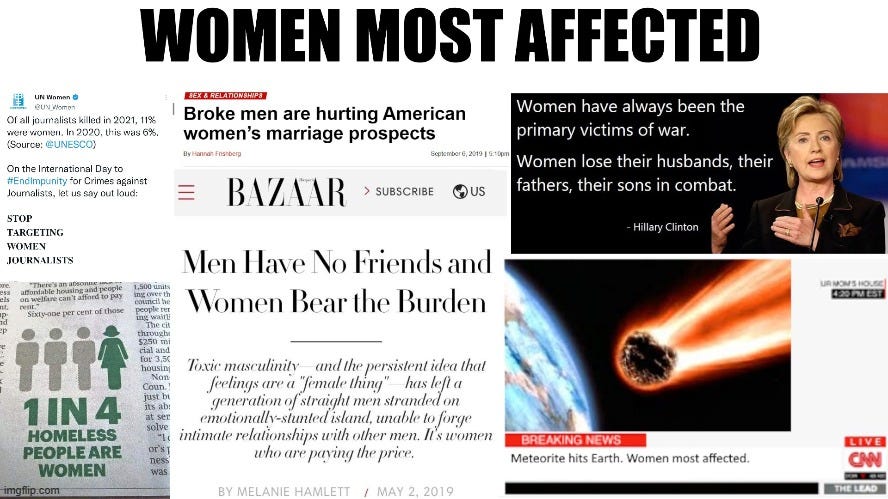
Men successfully commit suicide more often than women? Well, women try and don’t succeed more often, which means that men’s high suicide rates don’t matter and we should be helping these women who are clearly more existentially troubled. You need feminism.
You got called “gay” and “bitch” by bullies as a kid? Yeah sorry, but those are female-coded slurs and they exist because femininity is devalued. Your experiences as they relate to your own gender are irrelevant. Only by eliminating misogyny will little boys stop being called bitches or pussies or other insults that suggest inappropriate femininity. You need feminism.
Men die in wars and street violence at rates much higher than women? Yeah, well, who started the wars? Who is committing the street violence? Since it’s men, they need to man up and fix the problem themselves.4 The problems that women face that women also cause, however, are the fault of patriarchy because women don't have agency. You need feminism.
In this increasingly intersectional, identitarian feminist world, there was no room for men who didn't accept feminism as the solution, for reasons of past bad experiences or just observation and logical word association, as the best way to end gender-based discrimination and unfair, damaging gender essentialism that affected all of us. Since much of feminist theory holds that the oldest bigotry is misogyny and remains attached to the concept of patriarchy, there could, in their eyes, be no other way to help men without acknowledging that all pain men experienced on account of their sex was first and foremost rooted in misogyny.
Per critical theory, on which 4th wave feminist advocacy is based, men were the more powerful sex class relative to women, which meant that they were literally unable to be victims of sex-based discrimination as they were the only ones with the institutional power to enforce such a thing5. This also made them, by implication and necessity, personally responsible for their own oppression. Much like the idea that white people cannot experience racism and non-white people cannot be racist against whites, also rooted in critical theory, men’s issues had no place in gender discourse without being cloaked in the original sin of female oppression, and it wasn't “victim blaming” if the victim was a member of the oppressor class.
Vehicles for “third wave feminism”
I started dating my first husband, who we’ll call Thomas, some time after Kyle and I broke up. I knew him from my previous job at the bank call center6, and he was not only wickedly intelligent, but he was well-versed in feminist theory and after learning I was a budding feminist, bought me a couple books on the topic. To my surprise, he also supported my post-Kyle makeup and shaving boycott as soon as we started dating. He read Virginia Woolf and appreciated Beyoncé’s musical talent7 and he was open to things other guys usually weren't, but entirely comfortable in his masculinity (thank god; I was on high alert for potential closeted transness at that point). He and his attitude seemed like the perfect balm after Kyle.
Thomas and I hit it off quickly. About two years into our relationship, shortly after we got married, we moved together with his younger brother into the upper unit of a duplex above a friend of ours, a guy the brothers grew up with, and occasionally his girlfriend who would later move in with him. It was an ideal setup to have in your twenties, and with brother-in-law’s girlfriend always at the house, too, it felt like a party all the time.
Being the eager and argumentative baby feminist that I was and inspired by the downstairs neighbor who would, not long after she moved in, prepare to move to DC to become part of the leadership of the national Organization for Women (NOW), I was happy to spend time debating all things sex and gender with my live-in progressive, but mostly male, friends, buttressed by Professional Feminist Friend downstairs and the budding “Not A Feminist, But” girlfriend of my brother in law.
We spent a lot of time upstairs on our screened-in porch, smoking cigarettes and weed and drinking absurd amounts of beer and tequila. Our group consisted of a bunch of writers, artists, musicians, armchair philosophers, and ex-Christian religious theory nerds, so the conversations always took interesting turns, and gender dynamics came up often. After a few beers, I’d start noticing patterns: how the men would consistently talk over the women in the group when we tried to contribute to the conversation, or how they wouldn’t make as much eye contact with us when engaging the rest of the group as they would with the other men.
There were no classic sports metaphors (considering how I just described these guys, they wouldn’t understand them, either), but there were things that were esoteric and male-coded enough to make me feel left out and relegated to some kind of second-class “girl table.”8 I would call them out on it and they’d get defensive. I would be disappointed, thinking they’d really never understand and that we were doomed to have this chasm between us forever, even among fellow progressives and liberals and self-described rebels of the status quo. I chalked a lot of it up to most of them being formerly very religious and still subconsciously holding onto the patriarchal structures of their traditional upbringings.
Personalizing male struggles
In the midst of my ever-present frustration with the men in my life seeming to perpetually leave me out of their fascinating conversations, I also continued learning more about the specifically gendered issues men faced, like the downstairs neighbor, Alex, and his endless fight to see his son more often and all the money he’d sunk into court battles with his controlling ex. As someone whose experiences with custody and child support battles — as the child — went very differently, it was educational and eye-opening to hear about what he and the other Gen X and Millennial men I would get to know who were going through similar struggles to be in their own kids’ lives. Between the money, court bias I was learning about, and their exes’ controlling or manipulative actions, they were often in seemingly hopeless places. I deeply respected their unwillingness to back down, though, because far too many aggrieved dads often give up at one point or another, and sorry, but I cannot respect any man who won’t fight for his children (or woman, but let’s not pretend that happens with any kind of comparable frequency).
One guy would talk about body image issues — like overweight women, he would describe the certain stigma skinny guys can deal with in ways that thin women don’t, because they don’t have a body type that easily lends itself to various male “beauty standards.” Of course men had insecurities about their appearances and not living up to whatever ideal they were told they should — I had previously treated such things as basically a joke, not comparable to the more pointed and obvious ways in which women were subjected to the same.
I worked at a bank during this time investigating fraud, and I wasn’t shy about my feminist beliefs with my coworkers or male bosses, although I like to think I kept the banter fun rather than annoying or preachy. At one point, frustrated with all the letters I received from older customers generically addressed “Dear Sirs,” I joked to my boss that I wanted to reply to those customers addressing them by the wrong gender as petty, confusing revenge.
“April, this department is not a vehicle for your third wave feminism.”
He was the boss who later refused to be a job reference for me because I was “stubborn as hell and [had] no respect for authority,” and I found this response equally as hilarious. I thought of him as safely edgy, definitely a sexual harassment case in the making9 kind of old-school, Bill Maher-type liberal who liked pushing buttons but who, deep down, respected and liked women. I appreciated people with his kind of humor and enjoyed his occasional cutting take-downs. That kind of office banter is underappreciated among those who do not know the occasional silver linings of the soulless spreadsheet job.
Gotta look the part
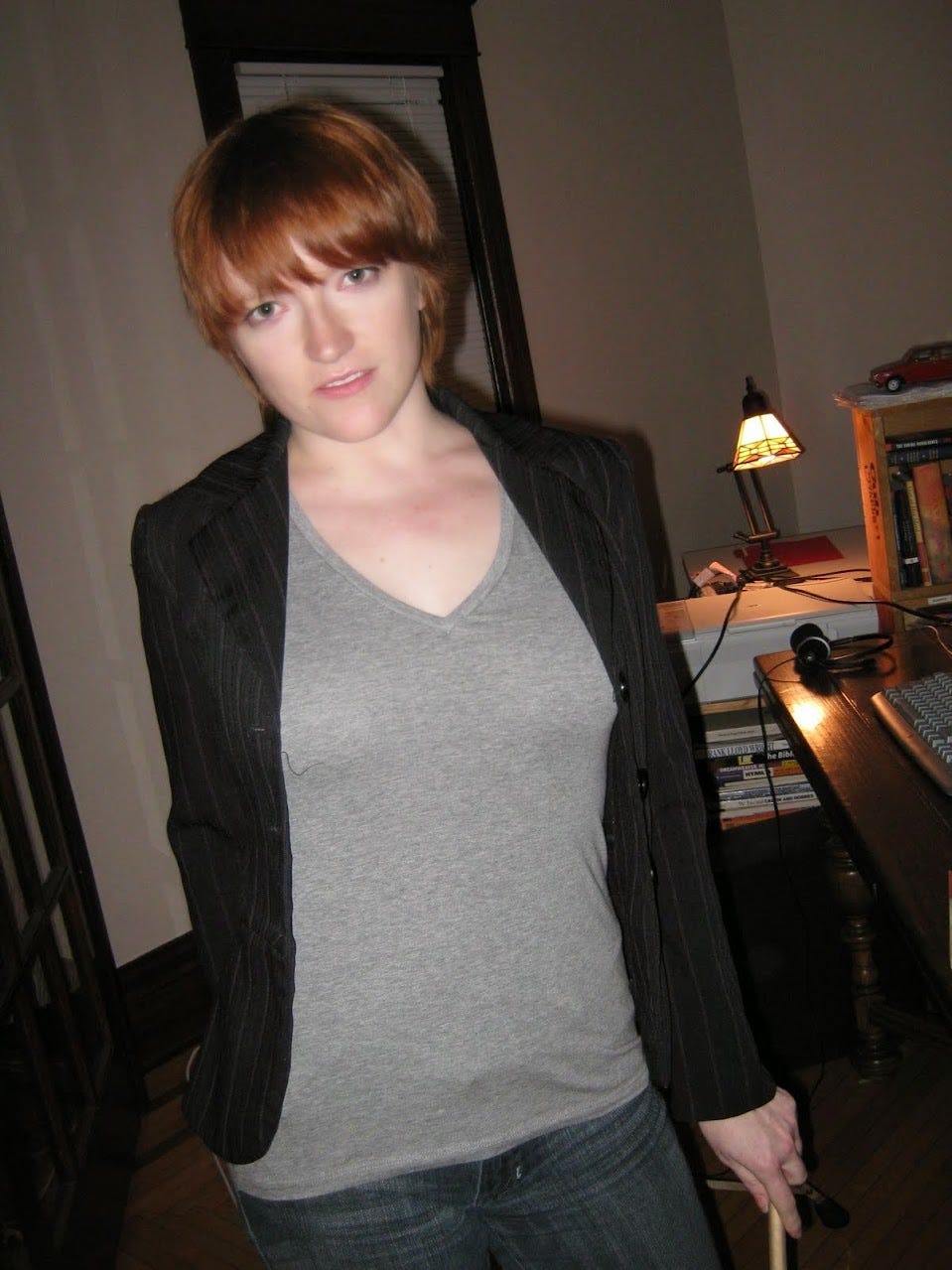
Like any self-respecting hipster/alternative/feminist hybrid young woman, I wanted my appearance to reflect my various attitudes and did not want to be confused for a dreaded normie. During these years and the several following, I was finally no longer afraid of being mistaken for a boy and tended to keep my hair relatively short, usually with an undercut, the top layer’s length varying. I’ve never really dressed in an overtly feminine manner on a casual basis and still don’t, but I played up the lack of traditional femininity in my wardrobe even more by wearing now-dated combinations of pieces like jeans with fitted blazers and classic Converse sneakers; just stuff that initially looked unusual together, but also properly signaling my identity to the right people — those who appreciated someone more “alternative” and who wouldn’t mistake me for a traditional kind of woman or, gasp, a suburban conservative. My nose was usually pierced, my earlobes were stretched, and I had a smattering of tattoos to complete the look. You know, a very stereotypical white Millennial hipster chick.
It’s not that I eschewed traditional feminine looks in general or anything; I still wore makeup and liked dressing up and looking fancily feminine when the occasion called for it. Mostly I just didn’t want to be personally mistaken for “normal.” And anyway, tattoos, piercings, and interesting haircuts just looked cooler to me overall, and I always appreciate a good, unique kind of look on people.
A male friend of mine made no secret of his preference for long hair on women and I, of course, heard it from plenty of others, too. My mom was the type who would immediately book a haircut the second a man told her he preferred long hair, and I adopted this stubborn attitude. I never really understood the preference, anyway, thinking to myself that if you’ve got a face that complements the hairstyle, it doesn’t really matter what length it is to be attractive. I realized later that it’s not necessarily about the style and how it complements a woman’s face to these men, it’s about the femininity that long hair represents, which is a large part of what those men are personally attracted to in women.
The beginning of the end
These experiences talking and debating with the frankly very patient men in my life, and many online with whom I exchanged a number of comments back and forth during the blogosphere years, gradually eroded my feminist sense of superiority in terms of it being the best way to address problems related to gender. It was too easy to debunk some of the more frequently-cited feminist claims, like the wage gap and certain rape statistics, and it seemed the underlying misandry, at least in practice if not theory, was too thick to penetrate with comment-section facts and logic.
In addition, while my introduction to transgender and queer theory had pulled me into feminism as a whole, the biological and anti-blank-slate realities contrary to the same theories were beginning to pull me back out.
Maybe sex differences are fine, actually
I thought about that Red Lobster parking lot revelation a lot. It was the defining moment in beginning my feminist “journey,” and it was a pivotal moment years later for that same journey’s eventual end.
There was, looking back, nothing hostile or misogynistic about what happened there, with the guys congregating to talk about cars or whatever else I wasn’t interested in enough to contribute to. It was not actually their responsibility to include me or anyone else in their conversation, and they were, in fact, free to chat about whatever interested them in the moment. These guys weren’t bad guys, and they were Millennials like me — the generation pretty well-known (and increasingly hated) for our utopian commitment to equality. They weren’t necessarily avowed feminists, per se, but they were products of their generation and did not actually treat us women like the accessories and NPCs I had so ruefully presumed back then. They were just dudes, talking about dude stuff, the way that women would sit around together talking about chick stuff, which I persistently claimed did not interest me.
In fact, considering my personality back then, it’s more likely that instead of accurately clocking these guys’ innocent conversation as sexist against me, I was really actually just jealous, not really wanting to be associated with “the girls” and wanting, instead, to be accepted by the boys’ club. But I just didn’t like cars (or whatever) enough to be included in that one conversation, and I didn’t yet accept that it was entirely okay and expected that sometimes men and women temporarily self-segregate in innocent ways because we’re often interested in different things and prefer to talk to each other about it rather than include people unlikely to be interested.
Eventually I would come to accept that interests and hobbies, like the ones my coworkers were talking about from which I felt excluded, are not inherently sexist just because they didn’t align with mine. They had no obligation to change either their interests or their conversation topics to include me, especially since I had no intention of doing the same for any of them, should they have ever felt excluded from a female-coded conversation among their female coworkers. And also, when my various interests did happen to be female-coded, that was okay, too, and nothing to be embarrassed about or eschew for more “interesting” and male-dominated interests if they didn’t come to me organically.
I also stopped thinking about men’s aesthetic preferences for things like long hair or shaved legs as inherently misogynistic. They were, in fact, just preferences, even if some of them did occasionally come from some “problematic” cultural messaging, and I had them about men, too, and all of that was both normal and allowed.
Every preference is not evidence of misogynistic intent, every exclusion not proof of intolerance, and every notable pattern of difference not evidence of culturally-mandated patriarchy. While I maintain my hopeful Millennial appreciation and desire for social equality, I no longer see the differences between men and women as hostile or indicative of malice, bigotry, or oppression by default. I see these differences now as usually complementary and even refreshing. Most of my hardcore feminist years were spent trying to compete with men rather than living with them and accepting our differences, and that competitive streak caused enough anxiety and constant pressure on myself to be different, cooler, and “better”than other women and men, whatever that looked like to me in each moment. And I have to say, letting go of that feeling that I needed to compete has been refreshing above all else. Like a weight off my strong-but-not-manly shoulders.
I use male pronouns for pre-transition Kyle because that’s what he wanted at the time, and frankly it’s just easier and more appealing than confusing people about my sexual orientation
Some research suggests transgender people have similar brains as the gender they more closely identify with, and also shows a clear difference between the brains of males and females
Obsessively reading people you hate is way more fun that reading people you agree with sometimes
The fact that this argument is often used by right-leaning people to discuss problems within the black community and is often called racist by the exact same people is somehow lost on all of them
He sat across from me. One day, shortly before he quit (by which he showed up, looked at his desk, turned around, and went right back out the door forever), he started telling angry customers ridiculous (but hilarious) things. He told one, who called in angry about fees and asked what we do with all the money we collect from them, that we use it for birthday parties and pony rides.
I once had to sit through a music theory-laced lecture about how “Crazy in Love” was the most brilliant piece of pop music to come out that decade and I maintain that one of his best recorded song performances was when he played a brilliant piano cover of “Baby One More Time” by Britney Spears
oh, the actual internalized misogyny of such a belief. I can appreciate the girls’ table a lot more these days
He was a boss, sleeping with at least one analyst while I was there, and even I actually went out with him a few times after I quit my job and got divorced. I guess being a rude asshole does work sometimes, as long as you’re funny enough in the process. People love to be affectionately roasted by someone observant and smart enough to see right through them. Not only is it funny, it actually makes you feel seen in a somewhat counterintuitive, relieving way
"...I started questioning a lot more of my interactions with men, suspicious of their motives, assuming the worst of most."
I really think that a huge amount of grievance culture stems from people assuming the worst. It's so easy to do, and it totally relieves the person making the assumption from having to consider their own responsibility.
I'm not saying that the worst is never true. There really are some awful people out there. But most people aren't awful, and don't deserve to be lumped in with those who are. Maybe I'm just an old idealistic gen-x'er, but I would much rather that individuals be judged on their own merits instead of being lumped into this group or that.
today I learned that Lirpa is April backwards