


I couldn't relate to the domestic labor arguments for the longest time. In fact, they were always such an annoyance to me that I would frequently think (or say) things like, “you absolute weirdo, how in the hell do you keep ending up with men who are no better than children in this way? I have never in my life found myself in such a position, and it is not hard to find normal, responsible men who know how to take care of their own household. Pick better, dummy.” Well, if I said it to someone to their face, I probably wouldn't actually call them a dummy. I would be nicer. But still.
Anyway, I've cohabitated with a fair amount of men in my life since my early twenties, and mostly, I was not only the one of us who cared less about chores and being tidy, but also the usual source of any given mess or general disorder.
The first guy I ever lived with was Daniel, when I was 20 and we were in college together. There was no on-campus housing, and the setup just made financial sense for the school year. It wasn’t just us living in the upper level of this duplex in Saint Paul, but one we shared with two, and then three, other roommates, one of whom also went to our school. One roommate was Daniel's younger brother and he was what you might call a bit of a neat freak. In fact, so was Daniel, although he was fairly chill about what other people did, except for that time he got mad at me for using his towel, which I thought was kind of silly.
Anyway, Jeremiah, the 4th roommate, was not anything close to resembling a “neat freak.” Jeremiah kept his messiness confined to his own bedroom, though. David, Daniel's brother, meanwhile, was the type to leave passive-aggressive notes about whose turn it was to do dishes or sweep the entryway and call mandatory house meetings about the status of the dust on the living room blinds.
Really the main thing I remember from this house, aside from all the other stuff, was how I moved out and then came back to visit a week later. It smelled great in there. Clean. Daniel's bedroom, which I used to share with him, was just off the kitchen and I could smell the clean laundry from the door to get inside.
“Yeah, you moved out!” He said to me when I remarked on this, in a playful and funny way but that still made me cringe because of how obviously true it was. That was one of those embarrassing wake-up calls that sticks in your memory for... awhile.
It was a while before I lived with someone else. The next guy was Kyle. Oh yeah, he was a neat freak more than anyone else I'd ever known. His mother was, too, which is who I was to understand was the source of his neurosis in this area. He was a jerk about it, though. Like, all the time. You never fucking do anything! You're a slob! Shit like that. He was just an asshole in general.
After I left that disaster of a relationship, the next guy I lived with was Jake, my first husband. He was neither a neat freak nor a slob. We lived together pretty easily. I hated to admit that Kyle's rather mean approach to my domestic laziness had seemed to work on me a bit, or maybe it just coincided with what was to be the natural point at which I began to mature a bit on this front, but still, I was more more likely to clean up after myself in a more timely fashion now, but I wasn't a total spaz about it. Neither was Jake. The way we worked was pretty similar and on the same page: we moved into this place, another upper-level of a duplex, this time in Minneapolis and we took our time decorating the place. We took great care in making this apartment in our very Millennial hipster neighborhood look like it belonged.
Once we had the place set up exactly how we liked, established a good baseline, we relaxed. A lot. Laundry all over the living room. Dirty dishes on top of the electric keyboard. Weeks’ worth of recycling piled up on the porch.

But then we'd survey it all one morning, weeks later, the enormity of the mess we'd happily been living in because we were busy doing fun stuff, hitting us and making us realize it was about time to do something about it. We got really obsessed with this online game called “Xplorers,” which sadly does not exist anymore but was basically just Settlers of Catan online, rebranded for copyright purposes. We loved that game and the online version was a great way to play it with others when we didn’t have more real people available to join in. That's what we did: got obsessive about projects or activities, neglected everything in pursuit of them, then snapped back into reality for however long to get the place back in order again. We made a good team that way. Neither of us got mad about it.
There was only one real time of conflict there, when we moved to a larger place and his younger brother joined us (I am noticing a trend). All three of us actually worked together at a bank. It was truly a pretty miserable series of jobs we had, but it was made better by the fact that we all went there together every day. Eventually, Younger Brother started dating someone we all worked with, and she became the de facto 4th roommate.
Then Jake quit his job. Kind of just had a bit of a moment and noped right out of there, nothing else lined up, no plans to get any other work. Younger Bro and Girlfriend and I all kept going to work, of course, also knowing there was no real way we could cover Jake's portion of rent, which, to be fair, Girlfriend wasn’t really paying, either, despite sleeping there every night, still on the lease at her apartment with her ex and paying monthly what she still contractually owed there.
Our landlord was nice about it, the wife of the drummer in the band Jake played in on occasion. She gave us time and flexibility, knowing we would make up the missing portion once our tax refund came back in a couple months.
But goddamn, the house was constantly a mess during this time. An absolute disaster. Jake wasn't doing anything anymore, not really his share and certainly not more than his share, which Younger Bro and I actually thought he should be doing, since he'd quit his job and left us to worry about how to stay in the apartment (another second story in another duplex in Minneapolis, my apparent favorite). He adamantly refused, though. Angrily objected to the notion that his being home 24/7 without earning any money or doing anything productive meant that he should contribute more to the household chores. He thought he should only have to do as much as we did. He never quite explained why but I did not agree with him and neither did Younger Bro. The agreement was that we were all splitting household duties, which included both domestic and financial responsibilities. Since he voluntarily stopped contributing financially, it only followed that he should pick up the slack elsewhere and at least keep the dishes done, the common areas picked up, the trash taken out. But he felt like that was no better than us designating him, against his will, as some kind of servant. Like it was beneath him. We certainly didn’t feel the same; we just thought it was the fair thing to do, given the circumstances.
We moved again and worked similar hours again and didn't have the same problem anymore.

Some years later I briefly moved in with Richard. The division of housework was such a non-issue that I don't remember enough about it to even write about it descriptively. We were both casual but appreciated cleanliness and easily just both did what needed to be done without even really needing to talk about it. The, wait for it, upstairs unit in the duplex where we lived in Saint Paul reflected that. It was fine.
It was more years before I'd live with another guy, and that guy would become my now-husband. I knew by this point what my tolerance was for tidiness, cleanliness, frequency of chores, what was fair and what wasn't.
I need to make it clear that until that point and for years after, I always worked. Always. At no point was I unemployed unexpectedly or without a plan. That was simply not something I could ever bring myself to do. I was not going to rely on someone else to pay for my life, even when I was married. How could I? I was not of a social or economic class which expects men to financially support women. I was a normal working class woman and the men I was in relationships with were like me. Similar educational and social backgrounds and doing similar work. I mean, many of my relationships literally started at work. The idea that I would not work was laughable to me, still is, even though I've been living that exact life for a few years now. It feels like an anomaly, something temporary, not the natural way of things. Not for me.
But my husband was actually kind of a mess (he would agree, okay). He had a good job and could pay his bills and didn’t rely on me to pay them, like my ex-husband had many times due to his inability to hold down a good job for very long. But we sure lived differently. And it was okay, in the beginning, because we didn’t live together. I have certain standards for my own living space, nothing crazy but I still like to maintain a certain sense of order, but I genuinely don't really care at all about the living spaces of others, assuming they're not actually dirty. Cluttered or not tidy is different than dirty.
Anyway, when we decided to move in together, I made it pretty clear that I wasn’t interested in living like that. In fact, that’s what I said, while we were discussing our moving plans. We were in his bedroom, and I looked around, and I said, “look, I cannot live like... this” and gestured around the messy room, clothes everywhere and random things all over the floor. He kind of laughed and said I wouldn’t have to, that he was much better when he was living with someone. I reminded him that he currently lived with two other people. He said, “you know what I mean!”
And it was fine, mostly. He spent a few months between jobs and would do most of the cleaning in our new apartment (second story, but not a duplex this time). Then we moved to Virginia. Even then, at that time, it was fine. He worked full-time and had a long and miserable commute that kept him away from home more than 12 hours a day pretty often, and I worked as a part-time server locally. I naturally took on the majority of the housework. It only made sense. We only began having conflicts about this when I finally found a decent full-time job, myself, and shared his miserable commute. Literally, actually: we carpooled every morning with two of my coworkers so we could use the HOV lane. We worked only a mile or two away from each other at that point. But working an exactly equal amount of hours and having the same amount of free time, I wasn't nearly as happy to maintain my same level of chores as I was when I worked half the hours, and I wanted some off my plate since I had drastically increased my own work hours to match his. He naturally wasn't terribly interested in increasing his workload at home, and he adjusted his standards accordingly, and our standards sure didn't match.
Now, let me tell you, that commute was the most miserable commute I’d ever experienced, and I have no idea how he did it all those years. I managed about four months before I insisted we move further north. He agreed, and so we did. And that’s when I suddenly found myself understanding the complaints of the women who bitched incessantly about this stuff. The point, though, is that I never felt any annoyance at all until we were both away from home full-time.
The reason this mattered is because I suddenly had much less free time, which made using part of my suddenly limited amount to keep the apartment clean and relatively tidy (I told you my standards are not insane; they're just higher than my husband's) now felt much worse.
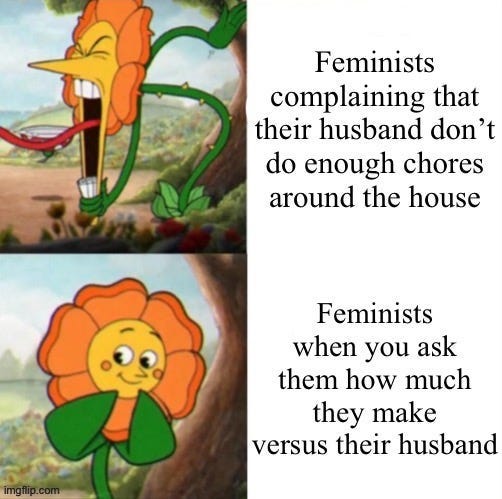
And that's where some people might invoke the argument above. Not my husband, but some people.
It's a stupid fucking argument.
Men by and large earn more money than women do. I am speaking generally, so if you’re an exception to this general rule, congratulations and I don’t care. Here’s the problem: it doesn’t matter how much money you make. Other things matter more. Your time, for example. Your time is valuable and your time is important. And it’s important to remember that the compensation you receive for the time you spend at work has nothing whatsoever to do with how much free time you should be able to enjoy outside of work.
Domestic work for your own home is, obviously, not paid. You can argue that in the case of a housewife or stay at home parent, your “compensation” is your spouse paying for everything while you take on all of the household and child-rearing tasks, and that’s fair and I agree with this framework, but in terms of a paycheck, absolutely no one is giving you one of those to vacuum your own house and to do your own dishes or raise your own kids. We are not a Marxist country, no matter how much the hysterical part of the right wants to pretend we are.
You do those things because you live there and they need to be done. Because those things are necessary to live in an enjoyable and healthy way. Everyone varies in their standards and expectations for what constitutes “enjoyable,” but everyone will agree (hopefully) that it is necessary to maintain a household that is at least clean enough that CPS isn’t going to come take your kids away from you about it, and that you aren’t living in the kind of squalor that qualifies you to be on the next episode of Hoarders. Everyone agrees that a certain minimum of cleanliness, even tidiness, are required to avoid bugs and mice and rats and other unsavory creatures taking up residence with you. Everyone mostly understands that if you can smell the sink full of dishes or the cat’s litter box when you walk in the door, you should be cleaning more.
Taking care of those things is work, and for the overwhelming majority of people, it is not an ideal way to spend one’s free time, because it is not actually fun. You may feel some level of satisfaction after finishing a deep clean or rearranging your living room or tidying up before people come over, but if one had to choose between having to spend all of Saturday making the house look like that vs. waving a magic want to have it done in half a second, I don’t know a single person on this earth who would choose the former, and I bet you don’t, either. And your one weird friend who actually enjoys cleaning up the dog shit in the backyard or scrubbing the toilet doesn’t negate this general rule.
Going back to the meme, though: please, go ahead and ask a feminist how much she makes compared to her husband. You know exactly what she'll say: wage gap this, under-valued feminine-coded labor that, etc and so forth and on and on. Have fun with that back and forth; I'm not terribly interested in it, myself. Women and men work different jobs for all kinds of reasons and I have been bored of arguing about the wage gap myth for years now.
Instead, let's talk about opportunity cost.
I'm no economist, which will become clear momentarily, but I'm still going to argue against this despite only just now refreshing my understanding of this economic concept mere moments ago. For anyone like me who doesn’t think about this shit in absolute cold economic terms naturally, the basic idea of “opportunity cost” is the overall economic cost of what you choose to do instead of making money in this context.

Splitting up your time on the clock versus off the clock is the proper way to judge many, if not most, forms of labor outside the home. If you are at work, you earn money via the company or whomever is in charge giving it to you at an agreed-upon rate for the job duties you perform. Most jobs do not allow you to simply choose to work as many hours as you want and be paid for them all; you must agree to a certain amount. If you were, in fact, to choose to work as much as you wanted, the company paying you would have no idea how to budget for your labor. You cannot get home from work, see a mess, determine it's not worth your time to clean, and go back to work to earn more money instead of doing the dishes at home for free. You presumably already work as much as you're allowed to work. You do not get unlimited overtime to avoid being responsible for maintaining your domestic life.
Furthermore, no one is doing this for you unless you pay them to do it— either directly with a contract and currency, or implicitly by agreeing to a division of labor that includes this from your spouse or live-in partner or roommate or whatever. There is no “next best option” that would be more economically valuable in this case. You either do your household chores, or you do something else that you would rather do because it’s more fun. You do not earn money for either of these activities. Making money is not some kind of constant activity that you have the choice to do every waking second of your life, that you just choose to take a break from once in awhile for no reason. That is not a real-world thing that happens.
What about the value of your rest that contributes in the background to your work life, keeping you ready to perform your job duties to the absolute best of your ability during the hours you are expected to work? Maybe you need every second of off-the-clock time to refresh and recharge, or you'll do a bad job working the next day. Doesn't that mean that the lower-earner (the woman, probably) should take over the necessary domestic work, sacrificing her free time, in order to support the man's? And what of the possibility that her taking on the bulk of that labor negatively affects her own ability to be energized enough to get a promotion or better, higher-paying job?
No, I don't think earning less money at work means that person should have to give up more of their free time to do more free labor than the person who earns more at work.
So when would I say “yes”? Well, when would you say “yes” to a woman who earns less being the one who needs more rest and relaxation than the higher-earning man? It’s pretty easy to come up with examples for when this would be appropriate. Nursing, for example. Most nurses are women, so it's a pretty straightforward one. Do you know any nurses? According to a cursory Google search, the median salary for a registered nurse in the US is $93,600. That’s pretty good! It’s also usually a very demanding job, both mentally and physically. Few people would disagree with this. The existence of your nurse friend who makes $150,000 sitting on her ass in a retirement home does not negate this general reality.
Say this nurse is married to a guy who works an office job and makes $176,000 a year for his efforts. His job is important and he makes a lot because of both said importance of the job and also because of his decades of experience doing similar work that made him good at it. His job is not anywhere near as demanding, mentally or physically, as his RN wife’s daily work, despite his income and overall importance of the job itself. Arguing that one job is more “important” than the other would be comparing apples and oranges. The value of his work is more abstract and not immediately tangible, and hers is more direct and she and her patients see the value of it as it happens in real time. Each of those jobs have many qualities that are important to the individuals immediately involved and the world at large. They're just too different to properly compare.
So who should do the bulk of the housework between this man and woman who work the same amount of hours each week and have the same amount of non-working free time, then? The woman who earns less but needs to conserve her energy to ensure she isn’t putting lives in danger when she’s clocked in? Or the guy whose job is important but who is able to nap at his desk every day and earns an entire working-to-middle class salary more than she does for it?
The point is that how much you earn at work cannot be the only calculation when determining how household labor should be shared. What’s more important is what each couple needs in order to maintain their happiness, productivity, and health. Every couple will be different, and also, every couple is not always playing fair. And it's not a simple mass delusion on the part of women that there is often a distinct and gendered lack of perceived fairness in many heterosexual relationships. It is nonsensical to claim or insinuate such a thing. If so many people have exactly the same complaint, naturally that warrants some attention. Obviously that means something is happening and it's not being invented out of thin air.
And, as I illustrated in the beginning of this essay, I am the prime example of someone whose relationships have largely been exceptions to this rule, but I can also easily see why and from where these frequent complaints are made, because I have known different types of people.
There is no reason to universally declare a specified amount of dishes, a certain amount of automotive repair, a certain amount of vacuuming, a certain amount of daycare drop-offs per husband and wife. There are myriad ways in which couples can organize their off-work time to contribute to the overall maintenance of their household in ways that feel fair to both of them. It’s also worth noting that doing the dishes every day is not going to feel fair to the woman doing it when the man’s supposedly equal contribution is mowing the lawn once a week or changing the oil in the car once every few months. It might feel fair if the woman hates those chores enough that doing the dishes every single day without help from him is a great trade-off for her. It might be even better if they just take the cars to Jiffy Lube or hire a housecleaner to do the annoying cleaning that they both dislike so much (although no such service exists for dishes, I’m afraid, unless one has a live-in housekeeper, which most of us sure don’t). But you know, people can't always do that. Most of us have to do our own chores.
I haven’t had a reason to complain about doing “more than my fair share” of housework in a long time because I haven’t had a full-time job in a couple years. It’s very easy to take on all the household duties (including mowing the lawn! I actually kind of like that one) when it is literally your only job. I wouldn’t dream of being publicly irritated with my husband for not having done laundry in two years when I’m home pretty much all day and he pays the bills. That would be some ridiculous entitlement on my part. Women who are in a similar position as me and who actually claim such a thing are acting like entitled brats, in my humble opinion. We are probably in agreement here. But that’s hardly representative of all the women who do complain. Most of the women who complain are working outside the home just as much as their husband is. So no, I no longer say or think things like “you absolute weirdo, how in the hell do you keep ending up with men who are no better than children in this way? I have never in my life found myself in such a position, and it is not hard to find normal, responsible men who know how to take care of their own household. Pick better, dummy.” Because it’s clear to me how people end up in mismatched partnerships where expectations are wildly different, and it’s not usually a situation people put themselves in on purpose, nor does it mean the one who cares or does less is a bad person with bad intentions. People are different. Shit happens, things change over time, expectations evolve for plenty of reasons.
Just try to be fair and understanding about it. Right? Listen to each other. It shouldn't be so hard. And honestly I've never seen that “Fair Play” game in real life, but it actually does sound to me like its haters are overreacting. If it helps couples organize their domestic lives in a way that feels fair to them, then wtf are you complaining about? Whatever works, man. Good for them.

I basically agree with you, but I also think a lot of women would benefit from having a bit more compassion for their male partners and taking a collaborative mindset to solving chore inequality. Instead I see so many women saying things like "I should never have to ask" and acting like their particular standards are obvious and correct, not up for negotiation at all, and the only reason her husband isn't meeting them is because he's lazy. It's a more condescending and adversarial mindset and immediately puts the husband in a defensive mindset. Women complain about feeling like they have to parent their husbands, but I think in many cases they put themselves in that position with their non-collaborate attitudes. If you want equality in your relationship, that means you don't get to be the queen of the home who decrees exactly how it should be managed with no negotiation.
(But also, granted, there are definitely some husbands who really are inconsiderate slobs no matter what his wife does.)
Maybe this means you set up a chore chart instead of relying on the husband to "just notice" when things "need" to be done. Maybe this means splitting who does which chores differently. Maybe you talk it out with an open mind and realize that you actually would be ok relaxing your standards in a couple areas. Maybe this means you have to accept *how* your husband does a particular chore may not be the way you would do it, but that's ok.
My wife and I both work full time and she out-earns me by $70k or so. She often works long hours whereas I work a standard 40 hours.
We probably split chores 70/30, because she’s a mess and I’m tidy, but if she told me “I earn 70% of our household’s income so you have to do 70% of the chores”, I would be pissed.
If one partner earns more, but that additional money isn’t contributing to an improvement in lifestyle, what is the purpose of that additional work? Is it transactionally worth it for the less-earning individual to do more household labor if there’s no benefit to their partner working a higher wage job or more hours?
It’s one thing to balance chores a certain way because somebody has more time to do so, that’s practically. It’s another thing to artificially bolster a power imbalance via earnings.
If one partner works part-time and the other full, it makes sense to me to divvy up chores differently.
Also, everyone is different and some people will be happy with imbalanced amounts of household labor. I’m naturally tidy, so an additional 10-15 minutes a day of passively picking things up isn’t even noticeable to me.